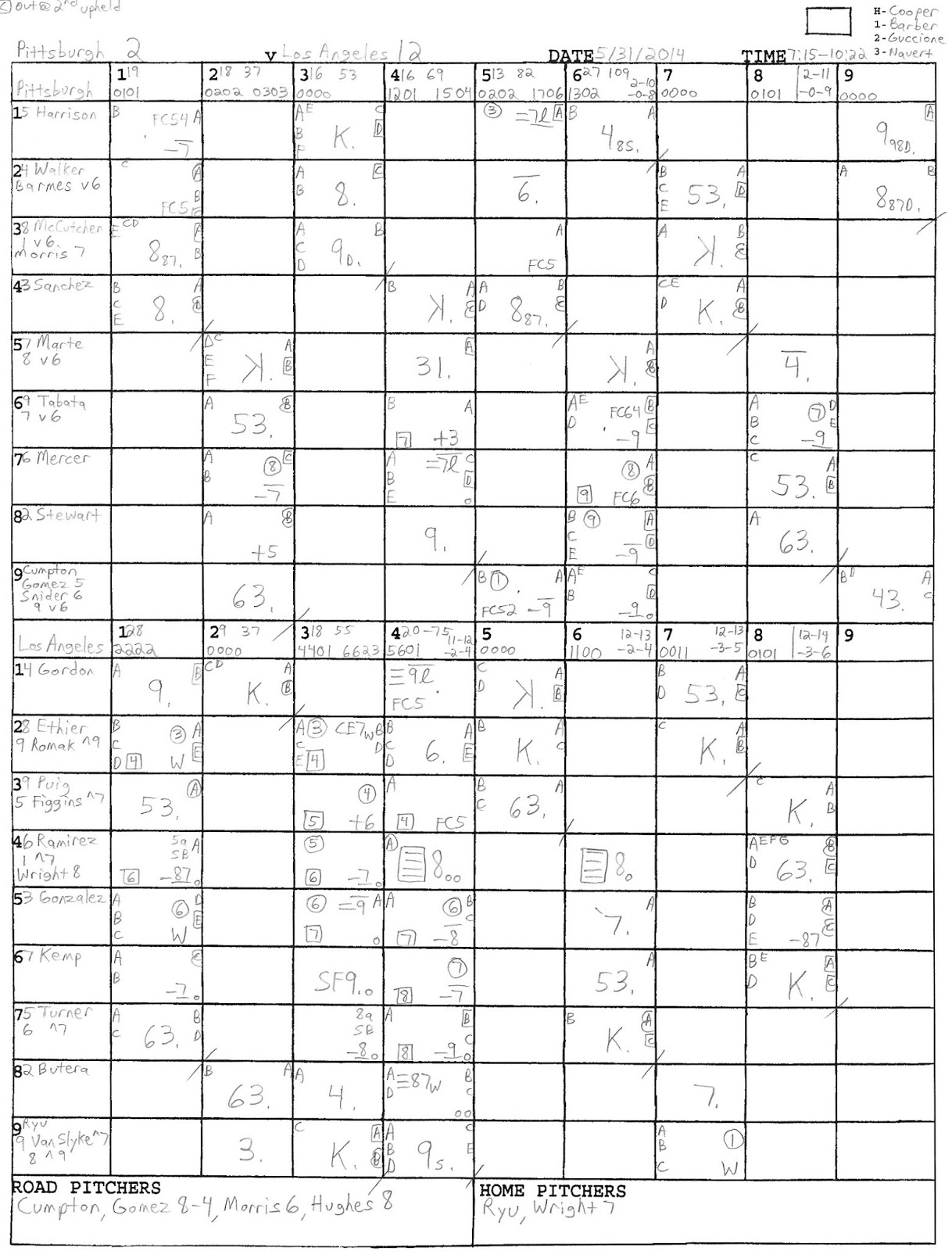
I have never been a big fan of mass-produced commercial scorebooks (yet I collect them). Partly it’s that I was influenced by Bill James’ comments in the 1986 Abstract that they are all too cluttered and put too much ink on the page before you start scoring. Partly it’s that my own taste in scorekeeping quickly became to collect as much information as possible. Partly it’s that I don’t care about the artistic representation of the diamond, and do just fine with breaking implicitly breaking a scorebox into quadrants to follow runners around the bases. Partly it’s because most are designed for baseball/softball dual use and for use in youth leagues, and thus have a bunch of unnecessary boxes for some indeterminate number of hitters 10-18 Partly it’s that it’s more cost-effective to print single sheets, they’re easier to store, you don’t have to worry about the book going out of print, and if you manage to misplace it you’ve only lost one game rather than dozens.
But I decided this year it would be a fun challenge to take a commercially-available scorebook and attempt to use it to record as much information as I could reasonably squeeze in about a major league game. After a trial run with an exhibition game, I refined my technique and used it for this, the fourth game of the season opening series between the Giants and Dodgers.
The scorebook I used was the “Rawlings System 17” scorebook, for two main reasons:
1. It’s one of the less appealing designs I’ve seen, which makes the scoring more of a challenge, although it does have enough physical space to do most of what I need.
2. They are cheap, and available across the whole country, as these are the scorebooks sold by Wal-Mart. You can get a book that scores 24 games for $2.97 (or at least you could as of July 2020), which is a relative bargain in the world of scorebooks.
In attempting to use this book, there is one immediate problem. For comparison, here is a scorebox from what I think is one of the best commercially-available scorebooks (although I don’t know that it’s still published, as it used to be available at Wal-Mart and marketed by Franklin), Dave Loucks’ “What’s the Score”:

Note that the diamond is basically centered in the box. There is plenty of room along each baseline to mark how the batter-runner advanced to that base, which is what I would do if using this sheet. Runs scored can be indicated by filling in the diamond (as most people do), or by some other symbol (I prefer a solid dot in the center of the diamond). I could do without the RBI box, and the “S” and “B” filled in for the pitches is bizarre to me – on a 9x9 scoresheet that means printing 405 little letters whose meaning should be obvious to anyone familiar with the game. Plus it makes it harder to record information in those spaces about what type of ball or strike it was (e.g. called strike, foul, swinging strike). All in all, though, a pretty clean design as these things go.
Contrast that with the System 17:

As you can see, the positioning of the ball/strike boxes and the circle make it impossible to use the area bordering home-first and third-home to record details about how the batter-runner advanced to those bases. This isn’t a problem if you are only interested in tracing progress around the diamond, but for the level of detail I need it is unacceptable.
My solution to this problem was to use the inside of the diamond to record how each base was gained. This presents another problem, as it eliminates on of the places where either a) the most important fact of all, whether a run was scored could be recorded or b) details about how a runner reached base is recorded.
My approach was:
1. Use the circle to indicate whether an out was made or a run was scored. If it’s left empty, that indicates by default that the runner was left on base. To indicate an out, I used a small dot; for a run, I marked a “X” through the circle. My normal inclination using a scoresheet with diamonds would be to use a dot in the center of the diamond to indicate a run scored and a smaller dot outside the diamond to indicate an out. I chose to use the dot for the out because I am used to it from my usual scoresheets which don’t trace a diamond, and because there will be many more outs in a game than runs, and the dot is quicker to write down.
2. Use what Bill James would call the “multiple choice quiz” at the top of the scorebox to record how the batter reached base (if it falls outside of the options of hits and a walk, like a hit batter or error, then write it in somewhere with room – see Seager’s HB in the bottom of the eighth. Since this doesn’t leave enough information for my taste about the hit (e.g. trajectory and location), I decided to draw it in one the field diagram. I used an open circle for a fly ball, a solid dot for a line drive, a dash for a groundball, and a squiggly line for a bunt.
The field location from line-to-line can be reasonably depicted; depth is much harder as the multiple choice quiz blocks much of center field, and of course the diamond is far out of proportion in relation to the diamond representing the infield. It also becomes a bit of a problem for infield hits, which need to be inside the diamond, which clutters that area when recording how a runner advanced. An example is Dubon’s at bat in the top of the third; the dash near first base in conjunction with circling “1B’ on the quiz indicates that it was a groundball infield single to first. The dash near second is not a dash at all – it’s a 1 indicating that the advancement to second was as a result of the leadoff hitter’s at bat.
Since all of this clutter can confuse things inside the diamond, I decided to draw a circle at any base where the batter-runner stopped to indicate that you should look for the corresponding notation of advancement. Usually this wouldn’t be necessary, as you would clearly see notation of the advancement outside the diamond.
In order to indicate ball/strikes, I used a dot for a called strike, a plus for a swinging strike, and a dash for a strike for strike one or two. Two-strike fouls were indicated with dots, first in the two small triangles created by the intersection of the ball-strike boxes and the third-home segment of the diamond, then in the area between the circle and first-home segment of the diamond (see Sandoval’s at bat in the top of the eighth, with five two-strike fouls). The order of the pitches including both balls and strikes can be inferred solely from the balls, which are marked by the number of the pitch in the at bat (e.g. if the first ball is marked “4”, that means that the first three pitches must have been strikes of some kind).
Some other quirks resulting from using this scorebook are:
1. Like many scorebooks designed for dual use with softball or youth leagues, there are a surfeit of lineup slots for what you need for an organized baseball game. If there were eighteen, you could try to squeeze both teams on one page, so 17 is pretty much the worst possible number, maximizing the wasted space without offering any possible benefit. I would utilize extra rows in case of extra innings; since there are nine columns, you can score left-to-right instead of up-to-down to create space for up to 17 innings.
2. For some reason the scorebook lists “HOME”, then “VISITOR”, which I find incredibly confusing, but thought it would be more confusing if I just ignored it (like I ignore the “error” column on summaries and instead use it for the number of walks).
3. There’s not enough space for pitchers, so I just used the first line for the starter, the pitcher whose performance is most worth filling in anyway. I only completed the pitch count, and once the five pitcher slots were used up, I listed the others on the same lines (except skipping the first which remains reserved for the starter). So that gets you up to nine slots for pitchers.
4. Originally I was trying to fit the outs into the diamond, and then I realized that was silly and I might as well fill up as much as the box as I could. So I think you’ll notice that starting in the bottom of the third the notation for the outs gets a lot bigger.